Galungan falls on Wednesday 13 January 2027 and again on Wednesday 11 August, Kuningan closes each festival ten days later on Saturday 23 January and Saturday 21 August, and Nyepi stops the whole island for 24 hours on Monday 8 March 2027. All three are open to visitors — what you need is a plan: which day to arrive, what you are allowed to walk into, and what happens to your flight if you are still on the island when the Day of Silence begins.
Galungan and Kuningan are the most beautiful ceremonies a visitor can walk into in Bali, and Nyepi is the strangest day you can spend here. They also work in completely different ways, and most people only understand one of them.
Galungan is a family festival. For ten days every household in a Balinese village cleans its house, cooks, makes offerings and decorates the street, and you are welcome to watch any of it. Nyepi is the opposite: it is a full stop. For 24 hours no one lights a fire, switches on a non-essential light, works, travels or plays music, the airport is shut, and the only thing to do is be indoors and let the island be quiet.
Our Bali calendar of events 2027 covers the whole festival year. This guide is the practical companion: what each ceremony looks like, where to stand, what to wear, and the small logistics that decide whether the day is magic or mildly annoying.
The 2027 dates on one screen
| Date | Day | What happens | What it does to your trip |
|---|---|---|---|
| 10 January (Sunday) | H-3 | Penyekeban — the village is cleared and prepared | The first sign that something is starting |
| 11 January (Monday) | H-2 | Penyajaan, the day of jaja — the rice-cake offering | Offerings appear on every doorstep |
| 12 January (Tuesday) | H-1 | Penampahan — offerings are placed and the penjor go up | The streets are transformed overnight |
| 13 January (Wednesday) | Galungan | The ancestral spirits return; the biggest ceremony of the ten days | The day to be in a village |
| 14 January (Thursday) | Manis Galungan | The "sweet day" after Galungan, the most sociable of the ten | The most relaxed village day |
| 23 January (Saturday) | Kuningan | The spirits leave; cremation rites and the closing procession | The second-biggest day |
| 24 January (Sunday) | Manis Kuningan | The "sweet day" that closes the festival | Everything winds down |
| 8 March (Monday) | Nyepi | The island stops for 24 hours | Nothing runs, nothing flies, nothing plays |
| 9 March (Tuesday) | Ngembak Geni | Forgiveness, cleaning, the Balinese new year begins | The island restarts |
| 10-11 March | - | Idul Fitri 1448 H | The same week carries the Islamic new year too |
| 11 August (Wednesday) | Galungan | The second Galungan of 2027 | The same villages, less international crowds |
| 21 August (Saturday) | Kuningan | The second Kuningan of 2027 | Quieter and more local than January |
Why do these dates drift every year? Because Galungan and Kuningan follow the pawukon, the 210-day Balinese calendar cycle, and always land on the same day of that cycle — Buda Kliwon, a Wednesday. Nyepi follows the Saka lunar calendar instead, which is why it moves through the Gregorian year differently.
Galungan: the ten days, day by day
| Day | Name | What is actually happening |
|---|---|---|
| H-3 | Penyekeban | The village common ground and temple are swept and cleared for the festival |
| H-2 | Penyajaan | The day of jaja, the yellow rice cake and sweet offerings set out for the spirits |
| H-1 | Penampahan | Offerings are placed; the tall bamboo penjor are raised along the streets |
| H | Galungan | The spirits return. Household purification (Mangku Carang) happens at dawn, then the temple ceremony |
| H+1 | Manis Galungan | The "sweet day" — the festival's friendliest day, with extra food and visiting |
| H+2 to H+9 | The quiet middle | Households work through their own purification, cremation rites are prepared |
| H+10 | Kuningan | The spirits depart. The final temple ceremony and the cremation procession |
| H+11 | Manis Kuningan | The "sweet day" that closes the festival and sends the village back to normal |
How to actually join a Galungan ceremony
Watching is easy. Being a guest rather than a spectator takes five decisions.
1. Go to a village, not to a hotel. The ceremonies happen in ordinary residential villages, not at tourist attractions. The Balinese villages most worth a morning are Sidemen, Penglipuran and Tenganan — all three keep their village temple, their household traditions and their festival calendar intact. Ubud's centre is also a fine base for the temple ceremonies, and our Penglipuran village guide covers that side of the island in detail.
2. Arrive between 07:00 and 10:00 on the Galungan day. The household purification happens at dawn, and the temple ceremony runs through the morning. By midday the crowds have thinned and the best light is gone.
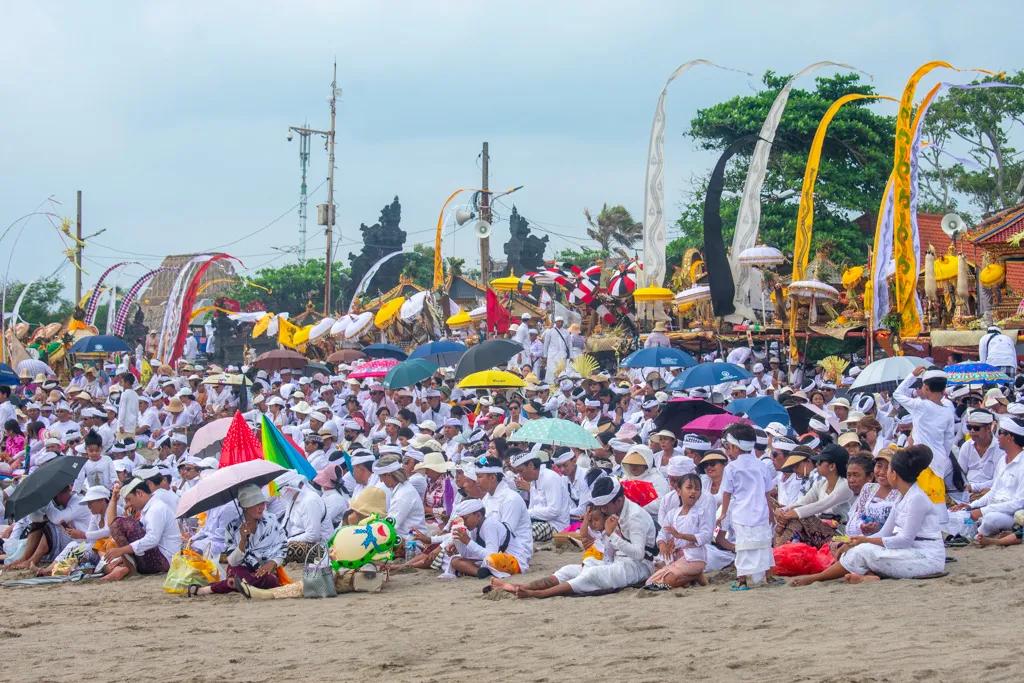
3. Let the village lead you to the main temple. Look for the pura desa, the village temple, and stand at the edge of its courtyard. The inner space belongs to the worshippers; a visitor who walks into the middle of a ceremony is the one person everybody notices.
4. Dress like you are going to a temple. Shoulders and knees covered, no swimwear, no beach sandals. Sarongs and sashes are normally lent at the gate, but bring your own if you can — the queue for one at the wrong moment is the difference between arriving and watching. The full dress-code guide is in our Bali temple rules and etiquette post.
5. Ask before you photograph people. Photographing the temple, the offerings and the street is fine. Photographing a family in the middle of their prayer is a request, not a right — and a quiet "may I?" in Indonesian is enough to make the difference between a welcome and a cold shoulder.
Penjor: why everyone photographs Galungan
The bamboo poles are the visual signature of the festival. A penjor is a tall bamboo mast raised at the edge of the road, wrapped at its base in black-and-white checked cloth, and hung with coconut leaves, fruit and flower offerings. They lean slightly over the street, one after another, for kilometres.
They go up on the night of Penampahan, which is why the transformation of a village between 12 and 13 January feels sudden: on Tuesday evening it is an ordinary street, and on Wednesday morning it is a tunnel of offerings. Small offerings also sit at the foot of every pole and on the steps of every house, refreshed daily through the festival.
Kuningan: the last day
Kuningan is the tenth day, and it is the closing of the cycle — the point at which the ancestral spirits leave the village and return to the realm of ancestors. It is also the traditional day for the cremation rite, ngaben, which is why families that have been preparing for a week finally carry it out.
The day has two moments worth planning around. In the morning, the temple ceremony. Later in the day, the procession of the cremation tower — the bade — moving through the village. Villages organise this differently, so if there is a procession you want to photograph, ask your host the night before rather than guessing in the morning.
Manis Kuningan, the day after, is the gentlest day of the festival: food is shared, everyone is tired and pleased, and there is no ceremony to schedule around.
Nyepi: what actually happens in 24 hours
Nyepi is the Balinese New Year — Saka New Year 1949 in 2027 — and it is the one festival on the island that visitors cannot join. You can be there; you cannot participate.
The rules are set for a full day and they are enforced socially, by pecalang — the traditional village security officers who patrol the streets, and who are known for escorting people home rather than for anything harsher.
| The rule | What it means on the ground |
|---|---|
| No fire | No cooking during the day, no candles, no fireworks, no open flame |
| No light | Only essential lighting; street lamps off, no flash photography, no screens glowing in the street |
| No work | Shops, offices and most businesses close for the day |
| No travel | Roads close, scooters stop, and the airport is shut — no flights in or out |
| No entertainment | No music, no parties, no cinema, no sport |
Electricity stays on, and that is what makes the day survivable: your hotel keeps its lights on at low level, there is food, there is water, and there is Wi-Fi. The silence is the point.
The 24 hours in order
| When | What happens |
|---|---|
| Early days of March | Melasti — the purification ceremony at a sea temple, typically three or four days before Nyepi, with the sea as a partner in the purification |
| The day before | Bhuta Yajna in each house and compound, with the temple, and the day's cooking |
| 7 March (Sunday) | Ogoh-ogoh — the giant demonic effigies are paraded through the streets and then burned at the cremation ground |
| 7 March, evening | Every household cooks for the next day, people gather, and the island goes quiet early |
| 8 March, from 06:00 | Nyepi begins. 24 hours of silence |
| 8 March, afternoon | Pengrupukan (also Ngrupuk) — silent processions move around the village carrying torches, before sunset |
| 9 March, from 06:00 | The silence ends and the island restarts |
| 9 March | Ngembak Geni — "fire of the soul". Neighbours and family forgive each other, homes are cleaned and the new year begins |
Etiquette: the short version
- Cover up. Shoulders and knees covered for every temple and ceremony, without exception.
- Walk around the offerings. The small baskets on the pavement are sacred and stepping over them is the single most common mistake visitors make.
- Do not touch the penjor. It is an offering, not decoration.
- Keep your voice down at the temple. Especially during the chanting.
- Never point your feet at a person or a shrine. When you sit on the floor, tuck your feet behind you.
- Ask before photographs. Always, and especially of people.
- On Nyepi, stay in. A day spent looking for something to do on Nyepi is a day lost; a day spent in your hotel is a day you will remember for the rest of your life.
Planning the trip around these dates
Book the room four to six months ahead. Nyepi is the busiest non-festival week of the year, and the January dates are close behind. Rooms around Ubud and the southern beaches fill first.
Take your flight out on 9 March or later — and be careful with the 8 March. The airport is closed on Nyepi day itself. If your international connection is on the 8th or the 9th, you are gambling with weather, a closed airport and a road closure. Leave on the 9th at the earliest, and on the 10th or 11th if you can.
Get your money out before the silence. Banks, ATMs and money changers close on Nyepi, and nothing runs to change a note on 8 March. Carry cash for the day.
Hire a driver for the days around it. Not for Nyepi itself — on 8 March no vehicle is moving — but for 7 March and for the morning of 9 March, when the roads are packed and the traffic jams last for hours.
Do not plan an activity on 8 March. Every tour, transfer, restaurant booking and spa slot you have made for that day will not happen. Confirm with your operator in advance and move it.
The quiet upside. Nyepi is also the best week of the year to be in Bali if your priority is calm rather than parties: no traffic, no construction noise, no crowds, and an island that is entirely asleep for one day.
Frequently asked questions
When are Galungan and Kuningan in 2027?
Galungan falls on Wednesday 13 January and Wednesday 11 August 2027. Kuningan, which closes the ten-day festival, falls on Saturday 23 January and Saturday 21 August 2027.
Can tourists join the Galungan and Kuningan ceremonies?
Yes. They happen in public village temples and in the streets, and visitors are welcome to watch. You should dress modestly, keep to the edge of the courtyard, ask before photographing people, and never walk over or touch the offerings.
Which day of the Galungan festival is the best one to visit?
13 January (the Galungan day itself) if you want the temples at full ceremony and the penjor freshly raised. 14 January (Manis Galungan) if you want a calmer, friendlier village day with the best food. 23 January (Kuningan) if the cremation procession is what you came for.
What is Manis Galungan?
The "sweet day" that falls on the day after Galungan. It is the most sociable day of the festival: households cook extra, people visit each other, and the ceremonies are lighter. Manis Kuningan does the same job at the end of the cycle.
What exactly happens on Nyepi, and can I go out?
For 24 hours from 06:00 on 8 March 2027 the island is silent: no fire, no non-essential light, no work, no travel, no entertainment, and no flights. You should stay indoors. Many hotels set up a quiet breakfast or a daytime service for guests, and the experience of spending one silent day on the island is genuinely one of a kind.
Is the airport really closed on Nyepi?
Yes. There are no flights in or out of Bali on 8 March 2027, and the roads to the airport are closed. If your international flight is booked for the 8th or the 9th, move it. The 9th is the first day flights move again, and it is still crowded.
What should I wear to a temple ceremony?
Clothing that covers the shoulders and knees. A sarong and sash are the standard, and temples usually lend them at the entrance, but bring your own if you can. No swimwear, no beachwear, no singlet and shorts at a village temple.
Is it worth being in Bali on Nyepi 2027?
If you want the festivals and the noise, come in January for Galungan and Kuningan. Nyepi is for the opposite kind of trip — the point of it is the silence, and the best thing you can do with it is nothing at all. Bring a book and stay in your hotel.
Send us your dates and we will hold the ceremony days
Tell us when you are in Bali and what you want out of it — the January village celebrations, the silent day in March, or both — and we will build the days around them: which base suits the temple and the travel, which slots to hold before the January dates fill up, which days to leave empty around Nyepi, and the driver you will need on the mornings when the roads are worst. One message, and we hold the slots until you confirm.
Tours to try in Bali
The tours we run ourselves, straight from the catalogue. Pay on arrival, free cancellation, and a WhatsApp reply within the hour.