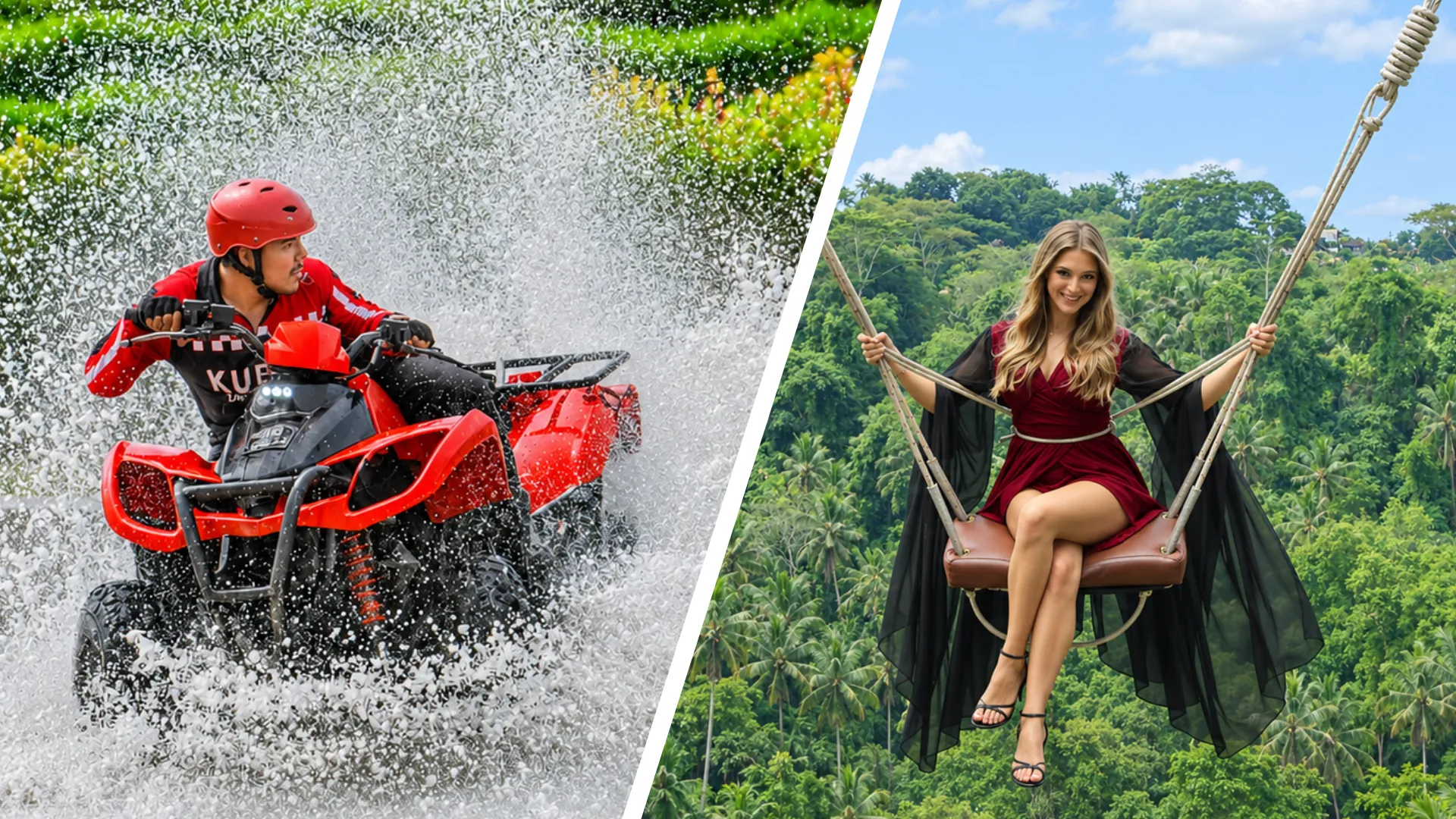
From the jungle valleys around Ubud to the volcanic highlands of Kintamani: what each area is like, what is worth seeing there, and which of our activities take you into it — written by the team that guides there every day.
01Gianyar regency · Central Bali
Ubud
Jungle, rice fields and Balinese art
Ubud sits in the green uplands of central Bali, between deep river gorges and terraced rice fields. For more than a century it has been the island’s centre of art and culture — royal families here supported painters, carvers and dancers, and foreign artists who settled in the 1920s and 30s helped make the town famous.
Today the centre is busy with cafés, galleries and markets, but you only need to walk ten minutes out of town to be on a ridge path above the jungle or between rice paddies. That mix — culture in the town, nature all around it — is why most travelers spend at least a few days here.
It is also where Bali’s adventure activities are concentrated. The valleys around Ubud have muddy jungle tracks, rivers and caves that make for some of the island’s best ATV routes, and the slopes above the rice fields are home to the famous jungle swings.
What’s worth seeing in Ubud
01
Sacred Monkey Forest Sanctuary
A forest temple complex in the middle of town, home to hundreds of long-tailed macaques. Keep sunglasses and snacks out of reach.
02
Tegallalang rice terraces
North of Ubud, a valley of terraced paddies carved into the hillside — one of the most photographed views in Bali.
03
Campuhan Ridge Walk
An easy path along a grassy ridge between two rivers, best in the early morning before the heat.
04
Ubud Palace & evening dance
The royal palace in the town centre hosts traditional Legong and Barong dance performances in the evenings.
05
Art museums & galleries
Museums such as Puri Lukisan, Neka and ARMA show how Balinese painting developed, from classical to modern.
02Gianyar regency · South-east Bali
Gianyar
Rivers, waterfalls and craft villages
Gianyar is the regency that Ubud belongs to, but the area east and south of Ubud has a character of its own. Rivers run down from the mountains through steep valleys, and the land between them is a patchwork of rice fields, villages and jungle.
This part of Bali is known for its craft villages, where whole communities specialise in a single art: silverwork in Celuk, woodcarving in Mas, painting in Batuan. Many workshops are open to visitors, and the town of Gianyar itself has a lively evening food market.
The river valleys also hide waterfalls and caves, which is what makes the area so good for an off-road ride. Our Jambe Asri ATV route follows muddy jungle tracks down to these hidden spots.
What’s worth seeing in Gianyar
01
Goa Gajah (Elephant Cave)
An ancient temple site with a carved cave entrance and bathing pools, dating back around a thousand years.
02
Tegenungan Waterfall
One of the most accessible waterfalls in Bali, with a wide pool at the bottom of a jungle valley.
03
Craft villages
Watch silversmiths in Celuk, woodcarvers in Mas and painters in Batuan at work in their studios.
04
Sukawati Art Market
A large traditional market for textiles, carvings and souvenirs — bargaining is expected.
05
Gianyar night market
An evening food market in the town centre, popular with locals for Balinese street food.
03Gianyar regency · Highlands north of Ubud
Tampaksiring
Holy springs and ancient temples
Tampaksiring is a highland village north-east of Ubud, along the valley of the Pakerisan River. This valley is one of the oldest sacred landscapes in Bali, with temples and shrines carved into its cliffs and built around its springs more than a thousand years ago.
The best-known of these is Tirta Empul, a water temple founded around a sacred spring. Balinese Hindus come here to bathe in its pools and purify themselves, moving from spout to spout with offerings and prayers — a ritual that visitors can respectfully take part in.
The Pakerisan valley is part of Bali’s UNESCO-listed cultural landscape, and the cool, green highlands around Tampaksiring are a quiet contrast to the busier south of the island.
What’s worth seeing in Tampaksiring
01
Tirta Empul
The holy spring temple where Balinese bathe for purification — the heart of our spiritual tour.
02
Gunung Kawi
Monumental shrines carved into a river cliff, reached by a long stairway through rice terraces.
03
Pakerisan river valley
The sacred valley that links the area’s temples, part of Bali’s UNESCO cultural landscape.
04
Tampaksiring Palace
The presidential palace built on the hill above Tirta Empul, overlooking the temple.
04Tabanan regency · West Bali
Jatiluwih
Bali’s grandest rice terraces
Jatiluwih lies on the lower slopes of Mount Batukaru, Bali’s second-highest mountain, in the regency of Tabanan. Its rice terraces stretch across the hills for as far as you can see, and they are among the largest and most beautiful in Bali.
The terraces are watered by Subak, a cooperative irrigation system that Balinese farmers have used for about a thousand years. Water is shared from temple to field according to the Tri Hita Karana philosophy — harmony between people, nature and the gods. Jatiluwih is part of the Subak landscape that UNESCO added to its World Heritage list in 2012.
Because the fields are worked by hand through the year, the view changes with the season, from flooded and mirror-like after planting to deep green and finally golden before harvest. Walking trails run right through the terraces, which makes Jatiluwih ideal for trekking.
What’s worth seeing in Jatiluwih
01
Terrace walking trails
Marked paths of different lengths lead through the paddies and along the irrigation channels.
02
The Subak system
See the canals, water gates and small field shrines that make up Bali’s UNESCO-listed irrigation network.
03
Red rice
Jatiluwih is known for growing Balinese red rice — try it with lunch at one of the warungs above the fields.
04
Pura Luhur Batukaru
One of Bali’s key directional temples, set in the forest on the slopes of Mount Batukaru nearby.
05Bangli regency · North-east highlands
Kintamani
Volcano, crater lake and sunrise
Kintamani is a highland area on the rim of the Batur caldera, a huge volcanic crater in north-east Bali. From the rim you look down on Mount Batur, an active volcano that rises from the crater floor, and on Lake Batur, the island’s largest crater lake.
Batur has erupted many times in the last century, and its lava flows have left wide fields of black rock and sand around the base of the mountain. The landscape feels completely different from the green rice fields of the south — which is exactly why the caldera is part of the Batur UNESCO Global Geopark.
The area is at its most dramatic at sunrise, when the light comes up behind Mount Abang and Mount Agung and the mist lifts off the lake. Our jeep tour drives across the lava fields to reach the best viewpoints for it.
What’s worth seeing in Kintamani
01
Sunrise over Mount Batur
Watch the sun rise behind the volcanoes from the caldera, with the lake below.
02
Black lava fields
Wide plains of cooled lava and black sand from past eruptions — best explored by 4WD.
03
Lake Batur
A crescent-shaped crater lake at the foot of the volcano, surrounded by small fishing villages.
04
Pura Ulun Danu Batur
An important temple dedicated to the goddess of the lake, on the caldera rim.
05
Natural hot springs
Hot springs on the lakeshore at Toya Bungkah, fed by the volcano’s heat.
Staying somewhere else?
Tell us where you’re staying — we’ll plan the route.
Send your hotel name, your date and the number of people. We reply on WhatsApp within the hour.