Bali Temple Rules and Etiquette 2026: What to Wear, What to Do, and What Not to Do
Short answer: every Balinese temple is open to you as a visitor. You do not need to be Hindu, you do not need to make an offering, and you do not need to know any of the theology. What you do need is shoulders and knees covered, a sarong (provided free at the entrance of the major temples), and the common sense to never step on the small woven palm-leaf offerings that sit on the ground everywhere.
Most of what people get wrong comes from not knowing what the objects around them are. This guide explains the rules, what the things in the temple actually mean, and the handful of customs that look strict until you understand why.
Quick reference: the temples visitors come for
| Temple | Where | What happens there | Good to know |
|---|---|---|---|
| Tirta Empul | Tampaksiring | A purification ritual at the holy spring | The one visitors can join as guests; sarong and prayer guidance provided |
| Uluwatu | Pecatu, south Bali | A cliff-top sea temple with the kecak dance at sunset | Monkeys are active here; dress code is enforced at the gate |
| Tanah Lot | Tabananan | A sea temple on a rock in the surf | The approach can be underwater at high tide |
| Ulun Danu Beratan | Bedugul | A temple on a lake in the mountains | Cold up there in the wet season; it often sits in cloud |
| Goa Gajah | Tivatubunan | A cave temple in the elephant-carved gorge | Monkey territory; the cave is dark and slippery |
| Besakih | Mount Batur | The "mother temple" of Bali | The largest and busiest complex on the island |
The dress code, in one paragraph
The rule is short and it is not negotiable: your shoulders and your knees must be covered. Most temples hand out a sarong and a sash at the entrance, so you do not need to bring one — but cover your shoulders while you are there, because the sarong is for your legs. A T-shirt and shorts with a sarong over them is acceptable; a tank top and short shorts without one is not. Thongs and swimwear are not accepted anywhere.
Add a light long-sleeved shirt and you are covered for every temple in Bali. Sarongs are also handed out for the ceremonies, and wearing one when you are handed it is expected.
Two smaller things: take off your shoes where the floor or the stone is raised, and do not wear a hat inside the shrine buildings — you can hold it at your side.
What you are allowed to do
- Walk through the entire temple complex. Outer courtyards, shrines and terraces are for visitors.
- Watch a ceremony from a respectful distance, and stay still and quiet while it happens.
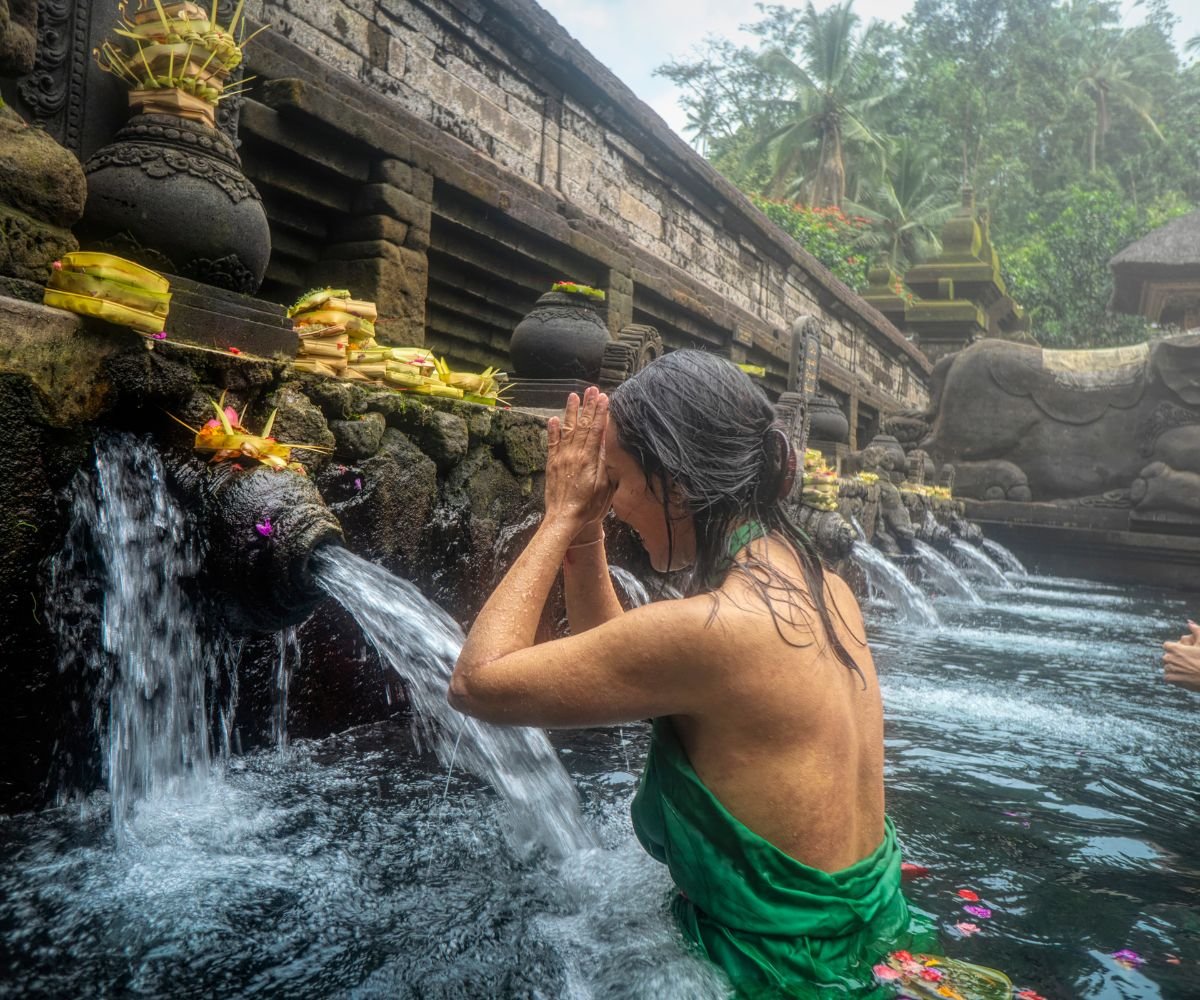
- Join a purification ritual as a guest at Tirta Empul, with guidance, if you come as part of an organised visit.
- Photograph the architecture — the gates, the statues, the split gates, the terraced shrines.
- Ask questions. Temple staff and guides are usually happy to explain what a ceremony is.
- Make an offering if you want to. A small tray of flowers, rice and incense is available at the gate, and there is no minimum — but it is genuinely appreciated.
What you must not do
- Never step over or on the offerings. The woven palm-leaf canang sari baskets sit on the pavement everywhere, in doorways and along the path. Step around them, every time.
- Never climb on the shrines, or sit on the platform in front of one. That is a seat for offerings.
- Never turn your back on a priest or a procession during a ceremony, and never walk between people carrying an offering.
- Never touch the statues or the offering trays. Some statues are wrapped in cloth and are dressed in sarongs — they are treated as people.
- Never use flash photography, and do not photograph people without asking. During ceremonies, photography is usually not welcome at all.
- Never block a procession. When you hear gamelan music and see people carrying something, stop and let them pass.
- Never fly a drone anywhere near a temple without a permit. It is illegal and the aircraft are confiscated.
The things you will see, and what they mean
Canang sari are the small palm-leaf baskets of fresh flowers, rice and incense that appear on every doorstep, shrine and roadside in Bali, every single day. They are daily offerings, placed as gratitude and as balance. Stepping on one is the single most common mistake visitors make — and the one locals mind most.
Penjor are the tall, curved bamboo poles decorated with coconut leaves that line the streets during Galungan and Kuningan. They are not decoration for its own sake: they are a marker of the festival and of the days around it.
Melasti is the purification ceremony that takes place at the sea before Nyepi, when Balinese people carry processions to the coast and cleanse themselves. It is one of the most photographed ceremonies on the island, and it is a genuine religious act, not a show.
Odalans are temple anniversaries, held roughly every 210 days. On those days a village temple throws a party that can run for days, and the temple is unusually busy and unusually welcoming.
The one custom that surprises visitors
In Balinese Hindu tradition, women who are menstruating do not enter the inner sanctuary of a temple. In practice, this means the inner courtyard around the main shrine — not the whole complex, and not the outer courtyards, which are where most visitors spend their time anyway.
If it applies to you, it is not a problem: the outer areas of every temple on this list are perfectly fine to visit, and the temple staff will tell you exactly which part to stay out of. The Tirta Empul tour includes guidance from a local guide who handles this routinely, so there is nothing to plan around and nothing to be awkward about.
Monkey temples: Uluwatu, Goa Gajah and Sangsari
Three sites are famous for their macaques, and the animals are opportunistic thieves. They take sunglasses, phones, bottles, small bags and hats.
What triggers them is food and eye contact. Do not offer them anything, do not stare at them, and do not hold a plastic bag of fruit in the open. If something is taken, do not chase the monkey and do not shout — that escalates it. Keep phones and glasses out of sight and walk past without engaging.
Where you can and cannot take photos
Photography is welcome in the courtyards and outside the shrines. Inside the small shrine buildings it is usually not, because that is where the sacred objects are. During a ceremony, many families consider being photographed deeply inappropriate.
The rule of thumb that works everywhere: if a ceremony is happening and there are people in it, put the camera down. Ask before photographing worshippers, and never photograph a child without a parent's permission.
Two days that change everything
Nyepi is the Day of Silence, the most important day in the Balinese calendar. The airport closes, the island stops, and even the staff stay home. Nothing on this list runs that day — plan around it deliberately, because being on the island for Nyepi is one of the most remarkable things a visitor can witness.
Galungan and Kuningan fall twice a year, about 210 days apart, marking the day dharma (good) defeats adharma (evil) and then the day the ancestors return to heaven. Temples are extremely busy, penjor line the streets, and the celebrations are at their most spectacular. It is the best time to see Balinese culture and the worst time for a quiet temple visit.
Frequently asked questions
Do I need to be Hindu to visit a Bali temple?
No. Balinese temples are open to everyone, including tourists of every religion. You do not need to make an offering, you do not need to pray, and you do not need to follow any religious practice to visit. You do need to dress respectfully and behave quietly.
What should I wear to a Bali temple?
Your shoulders and knees covered, and a T-shirt with shorts or a sarong is the standard. Sarongs are provided free at the entrance of the major temples, so you do not need to buy or bring one. Avoid thongs, swimwear and sleeveless tops, and bring a light long-sleeved shirt for the shrines.
Do temples in Bali charge an entrance fee?
Most do, and the fee is fixed and posted at the gate — for the well-known temples it is a small amount, and it usually includes the sarong and, at some sites, the ceremonial cloth. Carry a little cash, because the smaller temples do not take cards. Sarongs are free either way.
Is there a dress code at Uluwatu?
Yes, and it is enforced at the entrance. Shoulders and knees covered, no swimwear, and a sarong is provided. The same rule applies at Tanah Lot, Ulun Danu Beratan and every other major temple.
Can I take photos inside a temple?
Outside the shrines and in the courtyards, yes. Inside the small shrine buildings, photography is usually not allowed, because those spaces hold sacred objects. During ceremonies, put the camera away. Ask before photographing people.
Can children visit Balinese temples?
Yes, and it is a good experience for them. The outer courtyards, the gates and the views are the best part of a temple for a child, and the ceremonies are memorable. Bring a sarong for them too if they are wearing shorts, and keep them away from the offerings.
What are canang sari?
Small woven palm-leaf baskets filled with flowers, rice and incense that are placed on doorsteps, shrines and roads across Bali every morning as a daily offering. They are the most common thing you will see on the ground in a temple — and the most important thing not to step on.
What happens during the purification ceremony at Tirta Empul?
Participants are guided through the holy spring at the temple, under the guidance of the temple's priests, in a purification ritual. You are led step by step, and the guide explains what each part means. It is open to visitors of any religion as a guest, and it is the one ceremony on the island you can actually take part in.
Visit a temple with someone who knows the rules
The Tirta Empul spiritual tour includes hotel pickup within Ubud, a licensed guide who walks you through the ceremony and the etiquette, and lunch made from the offerings. If you are going to temples on your own, the dress code above is enough — but the context is what makes it memorable.
- Tirta Empul spiritual tour — the purification ceremony, with guidance
- ATV rides — three tracks around Ubud and Gianyar
- Rice terrace trekking at Jatiluwih — a two-hour guided walk
- Bali Swing — nine swings above Ubud
- Jeep tour to Mount Batur — sunrise over the volcano
Or message us on WhatsApp at +62 851-7516-3718 and we will confirm the timing, the pickup and the whole amount in one reply.
Related reading: is Bali safe to visit, getting around Bali, and the Bali events calendar.