Is Bali Safe to Visit? A 2026 Guide to Safety, Scams and Local Know-How
Short answer: yes. Bali is safe for the overwhelming majority of visitors, and most Western governments list it as a normal-precautions destination rather than a risky one. The everyday problems are ordinary ones — motorbike traffic, monkeys at temples, drink-spiking in Kuta, ATM tampering, overcharging by unofficial guides, and paper-work if you lose your passport. None of them are reasons to skip Bali; all of them are easy to avoid once you know what they look like.
This guide is written by people who run tours here every week, so it covers the things a local operator sees that a travel forum does not: which streets the criminals work, which temple monkeys actually take things, and what a legitimate transfer looks like.
Quick reference: the six real risks in Bali
| Risk | Where it happens | How to avoid it |
|---|---|---|
| Motorbike accidents | Every road, worst at night and in Kuta | Never ride as a passenger without a helmet; never rent a scooter without a licence and insurance |
| Temple monkeys | Uluwatu, Goa Gajah, Tirta Empul, Jatiluwih | Never offer food, never stare, never carry a loose phone or sunglasses |
| Drink-spiking and bag-snatching | Kuta, Legian, Seminyak beach clubs | Buy your own drink, keep it in sight, wear your bag on the wall side |
| ATM and card tampering | Kuta, Ubud, near banks | Use bank-branch ATMs, refuse help from strangers, count your money before leaving |
| Fake guides and inflated fees | Nusa Penida, Uluwatu, beach entrances | Agree the price before you board, check official entrance tickets yourself |
| Lost passport | Ubud, Kuta, airport | Keep a copy at two different places; a police report is required to leave the country |
What the official travel advice actually says
Bali is not listed as a high-risk destination by the governments that publish travel advice for their citizens. The advisories that exist for Indonesia point at ordinary petty crime, road safety, natural disasters and the rules around motorbike licensing — not at anything specific to Bali as an island.
The rules that genuinely bite at the border are entry rules, and they change often. Indonesia uses an electronic visa on arrival for most nationalities (30 days, extendable at the immigration office) and a physical visa on arrival as a fallback, and every international arrival is asked to complete a digital arrival declaration. Check the official immigration information before you fly rather than trusting a blog written last year — including this one.
Two rules are worth knowing before you land: you must have a visa or an e-VOA before arrival (visa on arrival is not the same thing, and immigration will not let you sort it out if you did not apply in advance), and you must leave before your visa expires.
The risks that actually catch people out
1. Traffic, not crime
If you are reading a safety guide and looking for the section on violent crime, you will not find a meaningful one. Bali's serious-crime rate against tourists is low. What actually hurts people here is the road.
Bali has no enforceable speed limit culture, motorbikes filter traffic in both directions, and drivers frequently ignore lights. The consistent rule is simple: if you are not licensed and insured to ride, do not ride. Rent a scooter with a proper licence, wear a helmet every single time, and never let a stranger push you onto one to "get to the next attraction in five minutes" — that is a sales tactic, not a shortcut.
As a passenger you still need a helmet, and it is worth insisting on one even for a two-minute ride. Most travel insurance policies require you to hold a valid licence for the motorcycle you rode, and without one they can refuse the claim.
2. Monkeys at the temples
This is the one that catches even experienced travellers. Monkeys at Uluwatu, Goa Gajah, Tirta Empul and the Jatiluwih rice terraces are macaques, and they are opportunistic thieves.
They take sunglasses, phones, bottles, small bags and hats. What triggers them is food and eye contact: offering a snack, holding a plastic bag of fruit, or staring at a young monkey while its mother is nearby. If something is taken, do not chase it and do not shout — that triggers an attack. Keep sunglasses and phones out of sight, keep food away, and walk past without engaging. A monkey that appears calm is not necessarily safe.
A monkey bite is a medical issue, not a joke: wash the wound with soap and running water for fifteen minutes and get to a clinic the same day. Rabies is present in Bali and is treatable if it is caught early.
3. Drink-spiking and bag-snatching in Kuta and Legian
This is the one serious crime issue that Bali has, and it is concentrated in a small area: the party strip around Kuta and Legian, and some beachfront bars in Seminyak and Canggu.
The mechanics are standard: a friendly stranger offers you a shot or a "free" drink, you turn around for a moment, and your bag has gone. The defences are dull but effective. Buy your own drinks and watch them being poured. Keep your phone in your front pocket, not on the table. Wear your bag on the wall side of your body, never on the open side. Do not walk the strip alone at 03:00, and take a Grab or a taxi home rather than walking.
4. ATM tampering and card fraud
Bali's ATMs are mostly legitimate. The pattern that does exist is that someone stands "nearby" while you use the machine and offers help with the machine, or offers to count your money, or asks you to withdraw a large amount and hands you notes that are not all real.
Use ATMs inside bank branches where possible, always cover the keypad with your hand, decline help from strangers, and count the cash before you walk away from the machine. Card skimming on Bali ATMs is not common, but it exists. If your card is a credit card, pay with the card and take a receipt.
5. Fake guides and the "this entrance is closed" routine
Two scams are worth knowing by name:
- The unofficial guide on Nusa Penida. You book a boat, and someone on the beach offers to be your guide, or tells you the popular viewpoint is closed and there is a better one. Legitimate operators have their own boat and their own guide.
- "The entrance is closed, take this one." In several places — including near waterfalls and temples — an unofficial attendant will claim the official entrance is closed or under repair and steer you to a different ticket. The entrance fee at places like Tirta Empul is fixed and posted, and the entry includes the sarong provided at the gate.
The defence is identical everywhere: agree the total before you board, ask what is included, and check official entrance prices yourself.
6. Losing your passport
If you lose your passport in Bali, you need a police report to get an emergency travel document, and you cannot leave the country without one. Two habits prevent most of this pain: keep a photocopy or a photo of the passport page in two separate places (one digital, one physical, not both in the same bag), and keep your passport in your accommodation's safe rather than carrying it on a scooter.
Which areas of Bali are the safest?
| Area | Safety profile | Notes |
|---|---|---|
| Ubud | Very safe, walkable | Low traffic, most sights within walking distance; watch out for scooter tourists on narrow lanes |
| Sidemen, Amed, Pemuteran | Safest and quietest | Small villages, little nightlife, no street crime to speak of |
| Nusa Penida | Safe, with one known scam | Roads are rough and motorbike hire is the risk; do not rent a scooter without a licence |
| Seminyak, Canggu, Uluwatu | Safe, busy | Busy restaurants and cafés; drink-spiking risk is lower than Kuta but not zero |
| Kuta and Legian | Safest of the busy areas, but the highest petty-crime rate | Heavily patrolled, but drink-spiking and bag-snatching happen here |
| Nusa Penida west coast and Sangsit | Requires care | Strong currents and rocky entry points at several beaches |
Bali is a small island — roughly 150 kilometres across — so almost everything is within a two to three-hour drive. The difference between "an hour away" and "three hours away" is the difference between a relaxed afternoon and most of a day in a car.
Health basics that are specific to Bali
Water. Drink bottled or filtered water, including for ice at street stalls unless the shop is busy enough that the ice is turnover fast. Bottled water is cheap and available everywhere, and most hotels and restaurants filter their own.
Food. "Bali belly" is usually bacterial, not viral: it comes from food that was not cooked through, or from water. Restaurants with high turnover are generally safe; a warung with one turnover a day is a gamble. Be more careful with salads and cut fruit from street stalls than with a properly cooked meal.
Rabies. Bali has rabies, and the source is usually monkeys and stray dogs. Do not touch or feed any animal. If you are bitten or scratched, wash with soap and water for fifteen minutes and get to a clinic immediately — rabies is nearly always fatal once symptoms start, and entirely preventable if treated promptly.
Dengue. The mosquitoes that carry dengue bite during the day, so repellent is not just for evenings. Use repellent, wear light long sleeves at dawn and dusk, and use a room with air conditioning or a fan.
Sun. Bali sits near the equator and the UV index is high all year, including in the wet season when it feels cooler. Sunscreen, a hat and water are needed even on an overcast day.
Temples. Dress codes are enforced: shoulders and knees covered. Sarongs are provided at the entrance at the major temples, but covering up first saves you the queue. Do not enter a temple while menstruating in some local traditions, do not step on the offerings that are placed on the ground, and do not stand in front of someone who is praying.
Do I need travel insurance for Bali?
Yes, and the fine print matters more here than anywhere else in Asia.
- Motorbikes. Most policies require you to hold a valid motorcycle licence — usually an International Driving Permit together with your home licence. If you are riding without one, a claim for a collision or a hospital bill can be refused.
- Medical evacuation. Bali has good hospitals in Denpasar and, increasingly, in Ubud, but serious cases are transferred to Singapore or Australia. Evacuation is the expensive part, and it is what a policy is really for.
- Adventure activities. Some policies exclude riding as a passenger, off-road driving, or watersports. Check that your cover includes the specific activity you are booking.
Any travel agent or insurer will sell a policy in ten minutes, but read the motorbike clause — it is the one that matters for a lot of travellers in Bali.
Is Bali safe for solo travellers, and for women travelling alone?
Yes, and it is one of the more straightforward places in Asia to travel solo. The main things to adjust are normal and apply to most places rather than to Bali specifically: no walking alone at night in Kuta or Legian, avoid the drinks-folder routine described above, use a Grab or a hotel-arranged driver at night rather than accepting a ride from a tout, and keep your accommodation's address saved offline.
The usual harassment — comments from passing motorbikes, someone persistent trying to sell you something — is the same as anywhere and is handled the same way: a flat "no" and keep walking. Do not engage, because attention is what they want.
Is Bali safe for children?
Generally yes, and the island is a very common family destination. The things to manage are practical rather than criminal: the traffic (no scooter rides as a passenger without a helmet), the heat and sun (midday outdoor activity is hard on small children), swimming (many beaches have currents and reef, so swim at a patrolled beach and check the flags), and monkeys (children are more likely to be approached by macaques, so keep food and toys out of sight).
Bali's temples are also a good family experience: the Tirta Empul purification ceremony is a genuine cultural moment that children remember, and the swings and ATV tracks are built for exactly that age group.
How we keep our guests safe
We run our own guides and our own vehicles rather than reselling third-party trips, which means the safety decisions are ours to make:
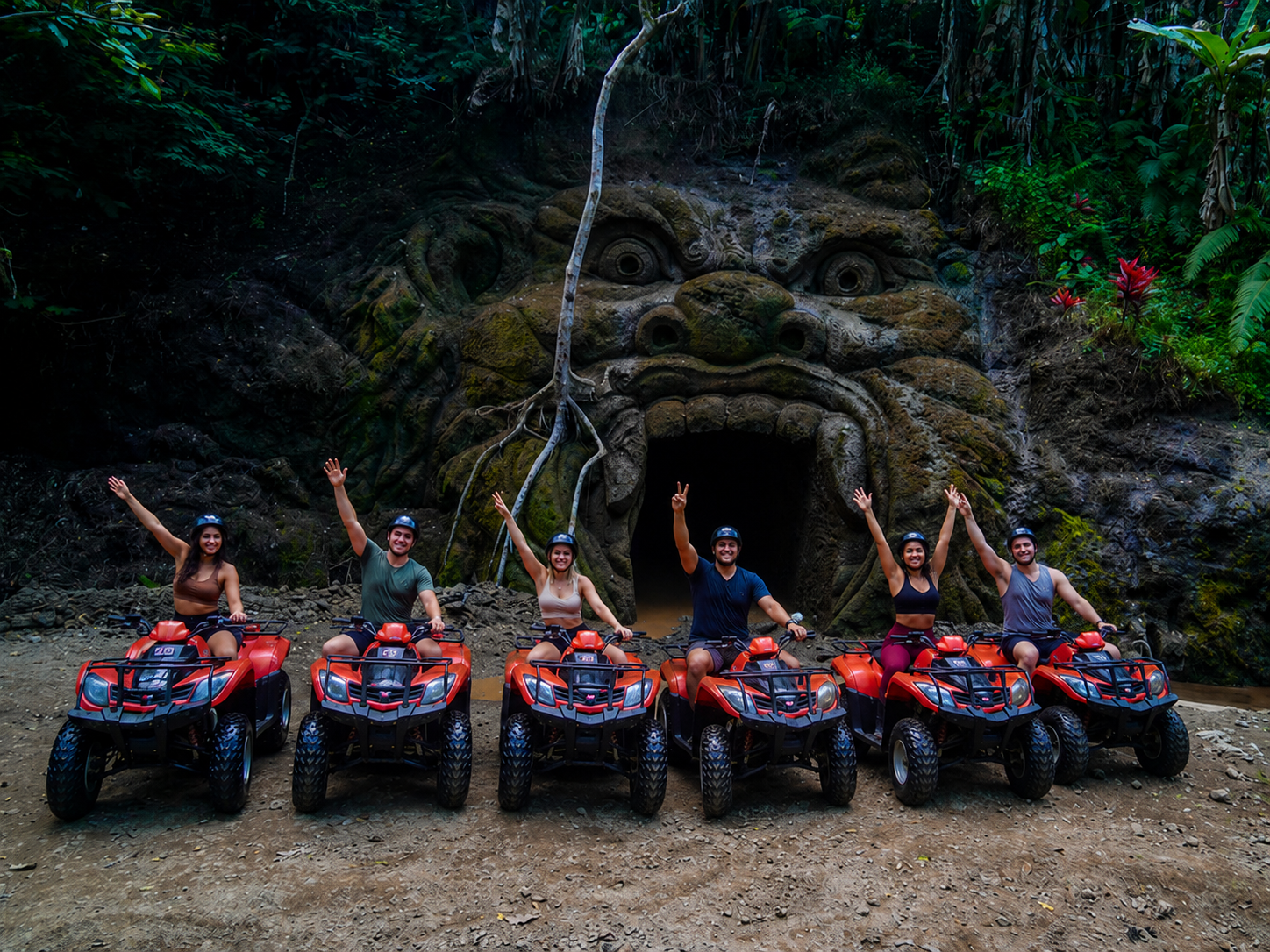
- A helmet and boots on every ATV rider, every ride, no exceptions, plus insurance as part of the package.
- A local guide on every track, riding with the group rather than following behind, and the group size capped so nobody is lost in the jungle.
- Our own vehicles for hotel transfer, so you know who is picking you up and where you are being taken before you get in.
- A licensed guide at Tirta Empul to walk you through the ceremony properly and explain the rules of the temple.
- Fixed start times and known meeting points, so nobody is left standing in a car park wondering where their ride went.
Ten-second safety rules
- Wear a helmet on every motorbike ride, as a passenger too.
- Never ride a scooter without a licence and insurance that covers it.
- Never accept a drink you did not watch being poured.
- Never offer food to a temple monkey or hold eye contact with one.
- Use bank ATMs, cover the keypad, decline help, count your cash.
- Agree the total price before you board any boat, car or guide.
- Keep a copy of your passport in two separate places.
- Cover your shoulders and knees at temples, and do not step on offerings.
- Wash any animal bite with soap and water for fifteen minutes and see a clinic.
- Carry repellent and sunscreen, even in the wet season.
Frequently asked questions
Is Bali safe to visit in 2026?
Yes. Bali is listed as a normal-precautions destination by most Western governments, and the realistic risks for visitors are traffic, monkey theft, drink-spiking and bag-snatching in Kuta, ATM tampering and tourist scams — all of which are avoidable with the habits above. Serious violent crime against tourists is rare.
Is Bali safe for solo female travellers?
Yes. Solo female travellers are common in Bali and most travel advice treats it as a normal destination. The practical adjustments are the same ones you would make anywhere: no walking alone at night in Kuta or Legian, buy your own drinks, wear your bag on the wall side, and use a Grab or a hotel-arranged driver at night. Most of the unwanted attention in Bali is verbal and ends when you keep walking.
Is Bali safe at night?
In Ubud, Sidemen, Amed and the resort areas of Seminyak and Uluwath, yes. In Kuta and Legian the streets are busy and policed, but this is where drink-spiking and bag-snatching happen, so the rules are the same as anywhere busy: do not accept drinks from strangers, keep your valuables on your body rather than on a table, and get home by taxi or Grab rather than on foot.
Are Bali's temple monkeys dangerous?
They steal things and can bite, and rabies is present in Bali, so treat any bite as urgent. Most incidents are opportunistic theft of glasses, phones, bottles and bags, triggered by food or eye contact. Do not feed them, do not stare, keep food and loose objects out of sight, and if something is taken, do not chase the monkey.
Can I rent a scooter in Bali without a licence?
Technically you can, but riding one without an International Driving Permit and your home licence is illegal, police do check, and travel insurance will usually refuse a claim for a collision or hospital bill unless you were properly licensed. If you have no motorcycle licence, rent a car with a driver or use Grab — it is cheaper than a hospital.
Do I need travel insurance for Bali?
Yes. The two clauses that matter are the motorbike requirement — most policies need you to hold a valid motorcycle licence — and medical evacuation, which is the expensive part if something serious happens. Check that your policy explicitly covers riding as a passenger and the specific adventure activity you plan to book.
What should I do if I lose my passport in Bali?
Go to the nearest police station and get a written police report — you cannot get an emergency travel document without one, and you cannot leave the country without one. Then contact your embassy or consulate in Bali, which issues emergency passports. This is why a photocopy of your passport page, stored separately from the original, saves so much time and money.
Is Bali safe in the rainy season from November to March?
Yes. The wet season changes what you do, not whether it is safe. Heavy rain in Bali is usually intense but short, and the most likely disruption is that outdoor tracks and swing parks close for the day. The Tirta Empul temple tour and the rice terrace trek work in any weather; our ATV rides run in the rain with extra precautions, though some tracks close after very heavy rain.
Plan a safe trip with a local operator
Every adventure we run uses our own guides, our own vehicles and insurance as part of the package, and we will tell you honestly which ones we would not put a small child or a nervous first-timer on. Send us your dates and how many people are coming, and we will match you to the right experience — or answer the question directly on WhatsApp at +62 851-7516-3718.
- ATV rides — three tracks, helmet and boots included, guide on every ride
- Jeep tour to Mount Batur — our own vehicle, breakfast at the sunrise point
- Rice terrace trekking at Jatiluwih — guided walk, hotel transfer included
- Bali Swing — a managed park with staff on site all day
- Tirta Empul spiritual tour — licensed guide, pickup included in Ubud
Related reading: which Bali adventure to book, the ATV guide for beginners, and why Bali is worth the flight.